
How Single Points of Failure damage your company valuation
Updated: May 6
What are Single Points of Failure and why do they matter?
Single points of failure have a fundamental impact on business value, as they are a significant source of risk for an investor or buyer.
In essence, if your business has a single point of failure, if it is dependent on one Director, or a handful of key individuals, clients, contracts, channels, or suppliers, then the risk to the buyer is significantly increased and your business valuation will be negatively impacted.
Examples of Single Points of Failure
Here are a few examples of Single Points of Failure you may recognise in your business:
Owners/Directors:
Owner dependence is usually the single point of failure that will have the greatest impact on your company’s valuation.
Perhaps you are the only person with knowledge of the business’s strategy, systems, and processes? Maybe you are the only person with decision making responsibility? Maybe you, the owner, are the brand name? Maybe you have all the goodwill in the industry? Perhaps the business relies on you and your network for sales?
If the success of your business is heavily reliant on you – the owner – or a handful of other key management individuals, then the buyer will perceive a significant risk to future growth and profits after the sale. Because if you, or those individuals, choose to leave the business, then any future profits – the key driver of value – will be negatively impacted.
Sales Personnel:
Proof of future sales and revenue are critical to ensuring a higher business valuation. If you rely on a handful of top-performing salespeople for the majority of your sales, then your business is a much riskier proposition to a buyer.
Few Large Customers/Large Contracts:
If the majority of your income comes from a very small number of customers or large contracts, then you will not be an attractive investment for a buyer. The risk to future profits is too great should customers leave, or contracts not renew.
A general rule of thumb is to make sure that you don’t have any single client or contract that accounts for more than 10% of your revenue.
Territory Dependence:
If you’re only active in one or two territories, then will your business be at risk if trade to those territories was restricted? Brexit is the prime example.
Supplier Dependence:
Do you rely heavily on a few suppliers? What if they went were to go bust or decide to change their payment terms?
Channel Dependence:
Are you dependent on a single channel of distribution? This is particularly relevant to online retailers. What if that channel was to disappear or change its terms of trade?
So, what can you do? Diversify!
Remove any single points of failure from your business.
The more diversified your approach, the more valuable your business will be as it de-risks the acquisition for the buyer.
For example, when it comes to owner dependency, in the years before a sale, the business owner should start to extricate themself from the day to day running of the business and delegate responsibilities to others so that the owner’s operational relevance is significantly reduced.
It’s worth noting that many buyers will reduce the perceived level of risk caused by single points of failure by making sure that the business owners and management team stay with the business post-sale for a specified period.
Similarly, some buyers may also demand a price reduction and percentage holdback if any large client contracts end within a certain period of the purchase.
Download our Free 54-Page Guide: How to Seriously Increase the Value of Your Business
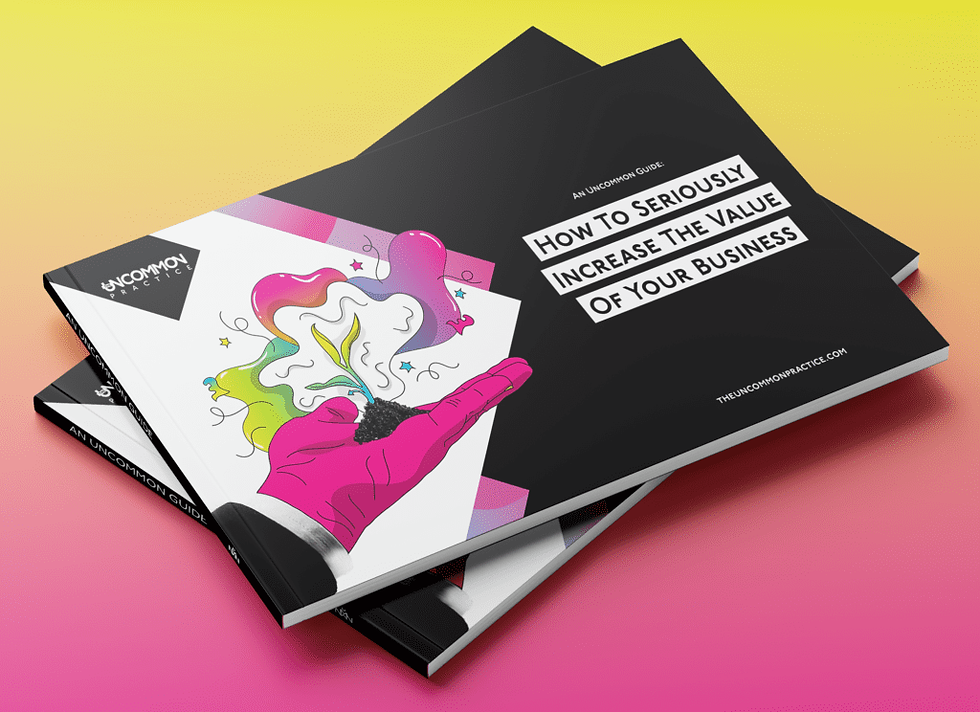
This article is taken from our free 54-Page Guide for Business Owners and Directors: How to Seriously Increase the Value of Your Business.
The guide will help you to get the sale value you want and deserve, and ensure that when the time comes to sell your business, your guts, drive, commitment and sacrifice will be worth it – literally.
You will also get a Valuation Scorecard to use in your own business to increase your business’s value.
Find out more about the guide and download it here.
Contact The Uncommon Practice
We exist to grow the value of our clients’ businesses.
If you’re considering selling your business in the near future, and you’d like to find out how we can help you to get the valuation you want, please get in touch with our Uncommon Advisers today.


Comments